
Hidden Gems
Episode One: The Town That Doesn’t Apologize

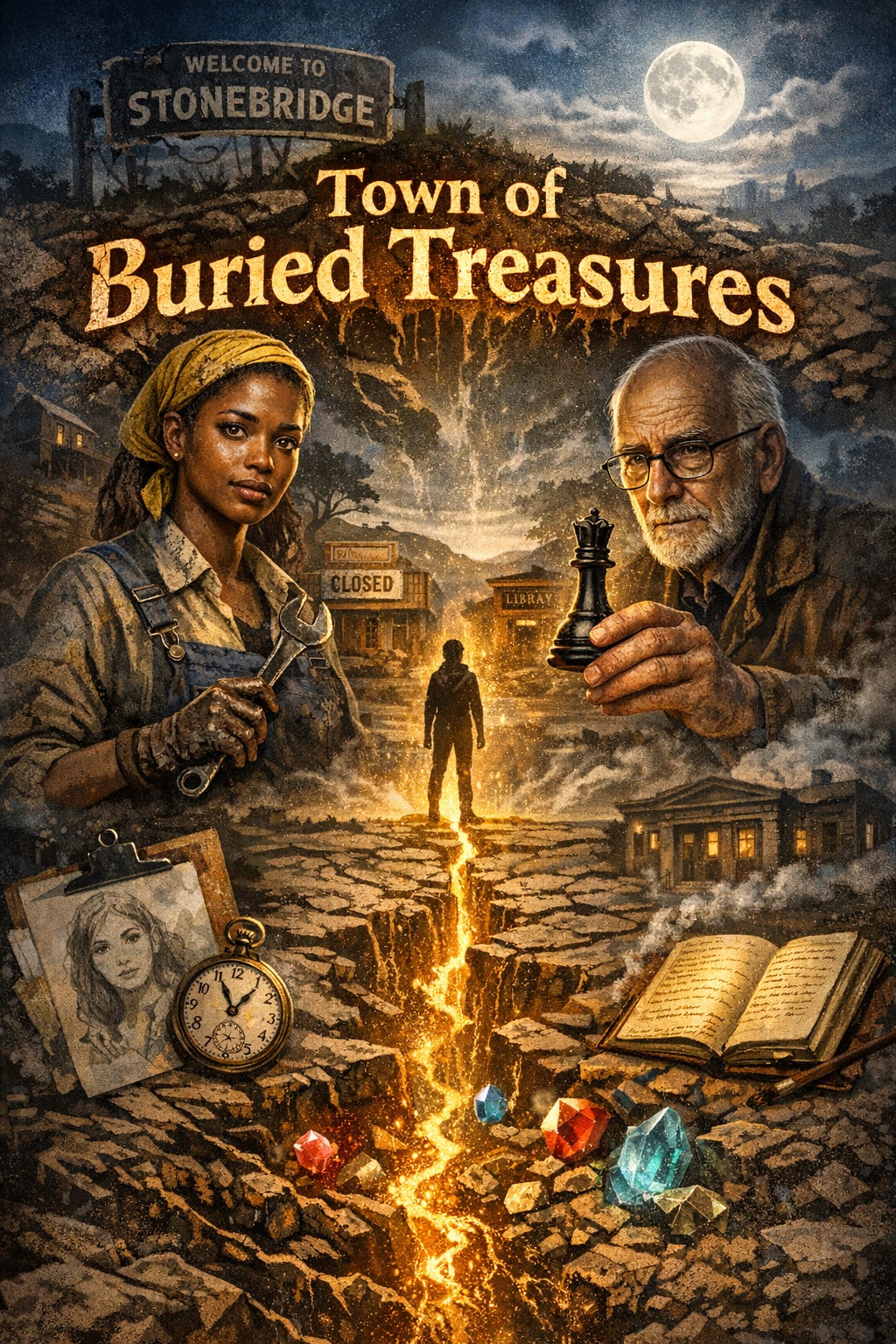
I did not always know I lived in a town of buried treasures.
At first, it just looked like dust.
Dust on window sills.
Dust on abandoned signboards.
Dust on people’s dreams.
They called our town Stonebridge, though there is no bridge here. There never was. Only a dried riverbed cutting through the center like a scar someone forgot to stitch.
People come here when they have been gently — or violently — misplaced.
No one arrives by accident.
At least, that’s what my grandmother used to say before she stopped remembering my name.
I was seventeen when I began to notice the pattern.
Not everyone in Stonebridge is invisible.
Only the ones who matter.
The first gem I found was not sparkling.
Her name was Amara.
She worked at the roadside mechanic shed, hands blackened with oil, hair tied in a scarf that used to be yellow. She could take apart an engine in thirteen minutes flat. No training. No certificate. No applause.
The boys there laughed at her when she first came.
By week two, they were asking her questions.
By month three, the owner took credit for her skill.
By month six, she stopped correcting him.
I remember the first time she looked at me and said, “It’s easier to let them think they built you.”
There was something sharp in her voice. Not bitterness. Precision.
Like a blade that had accepted its shape.
That was when I started to wonder if she knew something I didn’t.
Stonebridge is small, but not the kind of small that feels cozy. It feels folded. Like someone crumpled it and forgot to smooth it back out.
We have:
A closed-down cinema that still smells like popcorn.
A library with more missing pages than complete books.
A clinic where the doctor left five years ago but the nurse still shows up.
And people.
God, the people.
There’s Mr. Ikenna, who used to be a professor somewhere important, no one knows where, and now teaches children chess under a mango tree for free.
There’s Zahra, who sketches faces on brown paper bags but tears them up before anyone can see.
There’s Elijah, who repairs watches though time seems to avoid him.
And then there’s me.
I write things I never publish.
I see things I never explain.
And I have begun to suspect that this town is not unlucky.
It is buried.
The first crack appeared on a Thursday.
Not in the ground.
In Amara.
She didn’t come to the mechanic shed that day.
By afternoon, whispers had started — she ran away, she got married, she stole money.
Stonebridge feeds on rumor the way cities feed on electricity.
I found her by the dried riverbed at sunset.
She was staring into the cracked earth like it had offended her.
“You ever think,” she said without turning, “that this place isn’t small?”
I didn’t answer.
“You ever think,” she continued, “that it’s compressed?”
The word hung between us.
Compressed.
Like coal under pressure.
Like something waiting to transform.
She finally looked at me, and for the first time, I saw it clearly, not sadness, not frustration.
Containment.
As if something inside her was too bright and she had to hold it down with both hands.
That was the moment I realized:
The people of Stonebridge are not ordinary.
They are restrained.
Things began happening after that.
Subtle things.
Zahra stopped tearing her drawings. Instead, she left one on the library table. It was a portrait of the nurse, younger, radiant, almost glowing.
The nurse cried when she saw it.
Elijah fixed a watch that hadn’t ticked in decades. When it started again, three other broken clocks in town chimed simultaneously.
Mr. Ikenna began teaching chess strategies that felt less like games and more like survival training.
And Amara?
She began staying late at the mechanic shed.
Very late.
The first time I saw it happen, I thought my eyes were lying.
The generator had exploded, sparks, smoke, chaos.
The boys ran.
Amara stayed.
She placed her palm on the metal frame, closed her eyes, and something… shifted.
Not magically.
Not dramatically.
But the vibration of panic stilled.
The machine quieted.
And when she stepped back, the engine purred like it had been forgiven.
She saw me watching.
For a second, something almost like fear crossed her face.
Then it was gone.
“You didn’t see anything,” she said.
But I did.
And I don’t think she fixed the machine.
I think the machine responded to her.
That night, I couldn’t sleep.
I kept thinking about compression.
Coal becomes diamond under pressure.
But what do people become?
And who applies the pressure?
Stonebridge suddenly felt less like a forgotten town and more like a testing ground.
A place where potential is forced inward until it either shatters or crystallizes.
I started paying attention to patterns.
Every single person who seemed overlooked had once tried to leave.
Amara: scholarship denied.
Zahra:art school application “lost.”
Mr. Ikenna: tenure revoked under mysterious circumstances.
Elijah: fired for “incompetence” though every watch in town proves otherwise.
It was too consistent.
Too clean.
As if something nudged them back here every time they tried to rise.
That’s when the thought arrived.
Soft.
Unwelcome.
What if Stonebridge isn’t where broken people end up?
What if it’s where powerful people are sent?
The second crack appeared three days later.
This one was literal.
A fracture split through the dried riverbed, thin at first, then widening overnight. No earthquake. No warning.
Just a line running through town like a signature.
The mayor called it “natural erosion.”
But Stonebridge doesn’t erode.
It endures.
I stood at the edge of the crack with Amara and Zahra.
None of us spoke for a long time.
Then Zahra whispered, “Do you feel that?”
I did.
A vibration beneath the soil.
Not destructive.
Awakening.
Amara’s jaw tightened.
“It’s starting,” she said.
I turned to her. “What is?”
She hesitated. And that hesitation told me more than any answer could.
“You really don’t remember?” she asked quietly.
Remember what?
But before I could press her, a truck backfired in the distance, and the vibration stopped.
Just like that.
As if the town itself had inhaled and decided to wait.
Here is what I haven’t told you yet.
Sometimes, late at night, I hear humming.
Not from outside.
From people.
A frequency too low to name.
Like something resonating under skin.
The first time I heard it, I thought it was imagination.
Now I think it’s alignment.
Stonebridge is synchronizing.
And I have the strange, terrifying suspicion that I am not just observing it.
I am part of it.
Yesterday, Mr. Ikenna handed me a chess piece.
A black queen.
“Most powerful piece on the board,” he said. “But only when she stops pretending she’s a pawn.”
I laughed.
He didn’t.
“You’ve been writing, haven’t you?” he asked.
My stomach dropped.
I have never shown anyone my notebooks.
“How do you—”
He tapped his temple. “Some of us see moves ahead.”
Then he leaned closer.
“They’re watching for fractures. That’s how they know who to suppress.”
“They?” I whispered.
He didn’t answer.
Just walked away.
Tonight, the humming is louder.
The crack in the riverbed glows faintly under moonlight.
And I can’t shake the feeling that something is about to surface.
Not a monster.
Not a disaster.
A revelation.
If Stonebridge is a vault, it is unlocking.
If we are gems, we are cutting ourselves free.
And if someone has been keeping us buried.
They are about to learn what pressure truly creates.
I don’t know how this ends.
But I know this:
The town that doesn’t apologize is beginning to remember itself.
And when buried things remember,
They do not rise quietly.